In the ever-changing world of technology and fashion, very few products have achieved the rare distinction of remaining relevant for over three decades without substantial redesign. The Casio F91W Series is one such marvel. Since its introduction in 1989, it has become more than a digital wristwatch—it’s a symbol of reliability, minimalism, and timeless design. Cheap yet enduring, simple yet iconic, this small digital timepiece has quietly earned a place in the history of design and culture around the world.
Origins: A Watch for Everyone
The F91W was released by Casio Computer Co., Ltd., a Japanese electronics company already famous for its calculators, digital keyboards, and watches. During the 1980s, Casio had been at the forefront of the quartz revolution—producing accurate, low-cost digital watches that democratized timekeeping. The F91W, introduced at the end of that decade, represented the culmination of Casio’s expertise in efficiency and practicality.
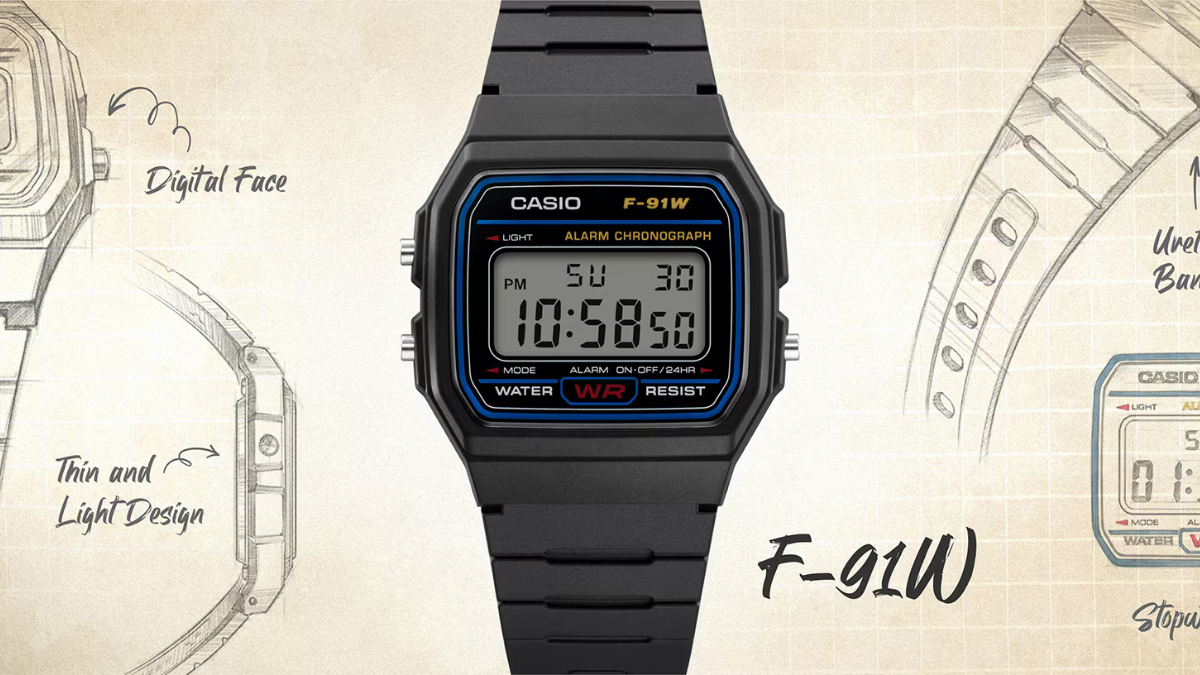
The design brief was simple: create a digital watch that was affordable, durable, and universally useful. At the time, advanced watches such as the G-Shock line were already popular, but Casio sought a more minimal model for everyday users. The result was a small, lightweight watch—just 21 grams—with all the essential functions: time, day, date, alarm, stopwatch, and backlight.
Its retail price was—and remains—astonishingly low, often under $20 USD worldwide. This affordability allowed the F91W to reach a massive global audience, from students and workers to soldiers and collectors.
Design: Form Follows Function
One reason the F91W remains iconic is its perfectly balanced design. Measuring 37.5 mm by 33.5 mm, it sits comfortably on nearly any wrist. The rectangular LCD screen displays the time in a simple, easy-to-read format, framed by a black resin case accented with blue and red lines—a color scheme that hasn’t changed in decades.
Despite its plastic build, this is surprisingly tough. The case is water-resistant (sufficient for daily use and light splashes), and its resin strap is flexible yet durable. Inside, the quartz movement runs on a CR2016 lithium battery that can last up to seven years—sometimes even longer.
Casio’s engineers designed the F91W for maximum efficiency: minimal parts, low energy consumption, and a sealed module that could withstand temperature fluctuations and minor shocks. The watch’s operation is intuitive, using just three buttons:
-
Mode – switches between time, alarm, and stopwatch.
-
Light – activates the greenish electroluminescent backlight.
-
Start/Stop/Reset – controls the stopwatch and alarm settings.
While the light is famously dim compared to modern LEDs. Everything about the design reflects an economy of thought and engineering—no excess, no flourish, just purposeful simplicity.
Functionality: Everyday Reliability
Feature set is basic by modern smartwatch standards, but it covers everything most people need. The digital display shows hours, minutes, seconds, along with day and date. It includes a daily alarm, an hourly time signal, and a 1/100-second stopwatch that can measure up to 59 minutes and 59.99 seconds.
One of its most appreciated features is its accuracy—Casio guarantees ±30 seconds per month, though many users report even better precision. The quartz module’s reliability has made it a trusted companion for professionals in demanding environments.
Perhaps the most impressive feature, however, is its longevity. There are countless stories of F91Ws running flawlessly for 10, 15, even 20 years without maintenance. The phrase “the watch that never dies” isn’t an exaggeration—it’s practically a design philosophy.
The Watch of the World
Few products have achieved the level of global reach that the F91W has. It’s been sold in virtually every country where Casio operates, and even in places where the brand’s presence is minimal, often appears as a generic digital watch.
From schoolchildren in Asia and Africa to mechanics in Europe and hikers in South America, this is universally recognized. Its low cost and high dependability make it especially popular in developing regions, where it’s often the first and only watch many people own.
Casio’s decision to keep the same design for decades has helped the F91W become a kind of universal timekeeping language—a product anyone, anywhere, can use and understand.
Cultural Icon: From Pop Culture to Politics
Over the years, it has transcended its humble origins to become a cultural icon. It has appeared on the wrists of characters in movies and TV shows, worn by celebrities and everyday people alike. For many, it represents a kind of retro authenticity—a reminder of the early digital age before devices became disposable or overly complex.
However, the watch’s ubiquity also gave it an unexpected, darker association: during the 2000s, intelligence reports revealed that the F91W was reportedly used as a timing device in improvised explosive devices (IEDs) by various militant groups, due to its reliability and availability. This led to the strange situation where owning a $10 watch could, in some contexts, arouse suspicion.
Despite this, the reputation among civilians and collectors remained untarnished. Instead, it underscored the watch’s engineering excellence—its consistency made it useful even under extreme conditions.
A Design Case Study
Designers and engineers often study the Casio F91W as a model of timeless industrial design. Its interface is purely functional; its proportions are perfectly balanced; its operation is intuitive. In a world where most consumer electronics are designed for planned obsolescence, stands out as a product that refuses to age.
The Museum of Modern Art (MoMA) in New York has even included digital watches like the F91W in discussions of functional design that transcends trends. It’s a piece of technology that fulfills its purpose so well that there’s simply no reason to replace it.
Variants and Collectibility
Though the F91W-1 (black) remains the most famous version, Casio has released several variants over the years:
-
F-91WG – gold-tone case and bracelet.
-
F-91WC – colorful transparent cases in blue, pink, green, and yellow.
-
F-91WM – metallic finishes in silver and gunmetal.
-
A158 and A168 – stainless-steel cousins with similar internals but a more premium feel.
Collectors often prize these variants, though their value rarely exceeds modest sums. What makes them special isn’t scarcity—it’s the story and philosophy behind them. Many people collect F91Ws from different countries or years as a kind of “global design map.”
The Philosophy of the F91W
Embodies a philosophy that has become increasingly rare in the consumer electronics industry: the idea that a product can be both affordable and long-lasting. It rejects the trend of constant updates, software dependencies, and fragile fashion cycles.
Instead, it represents stability—a constant reminder that good design doesn’t need reinvention. The same model that worked in 1989 still works flawlessly in 2025, unchanged in function or form.
The watch’s quiet humility is perhaps its greatest strength. It doesn’t need to boast luxury materials or complex interfaces; it simply does its job, year after year, for everyone from astronauts to schoolchildren. In an era of smartwatches that need daily charging and software updates, it feels almost revolutionary in its simplicity.
Why It Endures
It can be summed up in three principles:
-
Reliability – It just works, and keeps working.
-
Accessibility – Anyone can afford and use it.
-
Design Honesty – Nothing is decorative without purpose.
Casio has understood that innovation doesn’t always mean change; sometimes it means perfection through consistency. Achieved a kind of cultural immortality that few modern gadgets can claim.
More than three decades after its debut, Continues to sell millions of units every year. It remains a staple of Casio’s “Standard Digital” line, proof that good engineering and honest design can outlast trends, fads, and even generations.
Whether worn by nostalgia enthusiasts, minimalists, or those simply in need of a trustworthy watch, it has earned its place as one of the most successful timepieces ever made.
In a world obsessed with the new, the Casio F91W stands as a quiet reminder of the enduring beauty of functional simplicity—a digital heartbeat that never stops ticking.