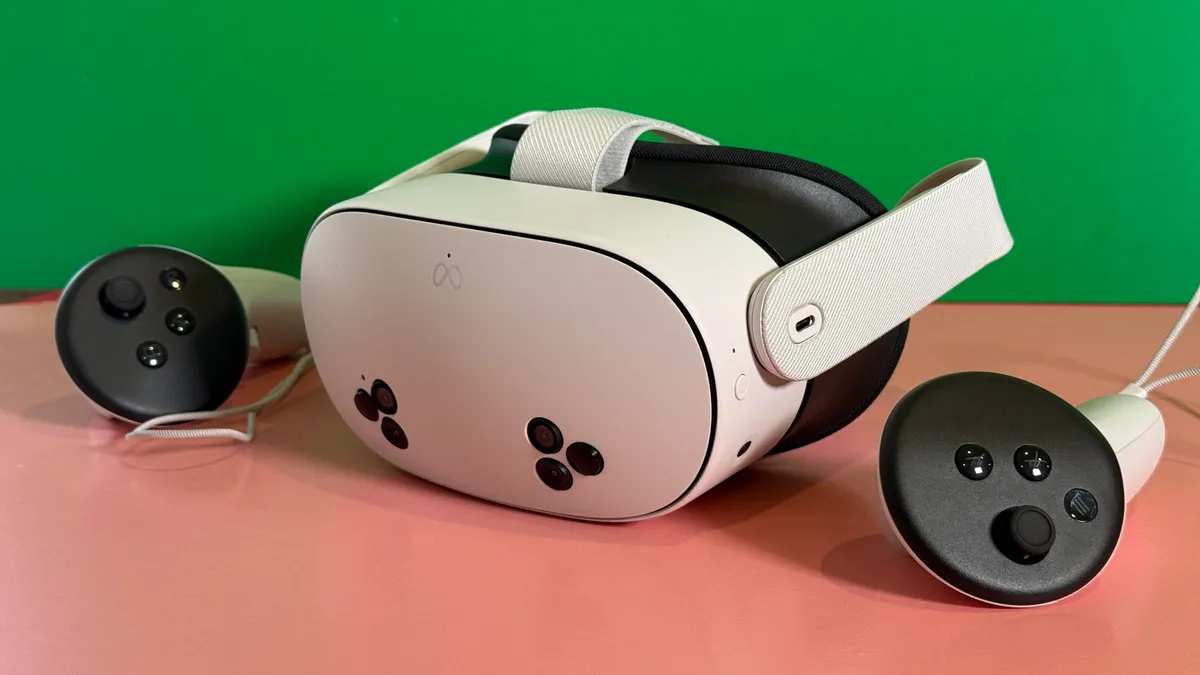
Virtual reality has evolved dramatically over the past several years, shifting from a niche technology to a mainstream platform for gaming, productivity, fitness, and immersive entertainment. Among the leaders in this industry is Meta, whose Quest line of standalone headsets has redefined accessibility in VR. Represents the company’s newest approach to blending affordability, performance, and mixed-reality experiences for a broader audience. Positioned as a more budget-friendly companion to the flagship Meta Quest 3, the 3S brings high-end features to a mid-range price point, making it a compelling option for new and experienced users alike.
What Is the Meta Quest 3S?
A standalone VR and mixed-reality headset released by Meta in 2024 as part of the company’s quest to expand its XR ecosystem. The “S” in the name reflects the headset’s streamlined focus: offering the essential strengths of the Quest 3 while removing premium components to bring the price down.
The 256GB version provides double the storage of the base model, allowing users to install large VR titles, record gameplay, store media, and use apps without frequently deleting content. With VR games increasing in size (some modern titles exceed 10–20GB), the added storage is a significant advantage.
Design and Build Quality
The Meta Quest 3S carries a familiar yet refined design language. Unlike earlier Quest models that had a bulkier front plate, the 3S is noticeably slimmer and more ergonomic.
Comfort and Fit
Meta has prioritized comfort, making the 3S suitable for extended sessions. Its lightweight build helps reduce face strain while adjustable straps make it easy to find the right fit. The front-heavy feeling is reduced compared to older models, although not as perfectly balanced as the premium Quest 3.
Materials and Durability
The shell is primarily composed of reinforced plastic with a matte finish that resists smudging. The face interface is soft and breathable, offering solid comfort even during longer gameplay sessions.
Weight
At about 514 grams, the 3S is lighter than many PC VR headsets and comfortable enough to use for fitness apps, rhythm games, or productivity sessions.
Display and Visual Experience
The Meta Quest 3S strikes a balance between quality and affordability by using LCD displays with 1832 × 1920 resolution per eye. While not as sharp as multi-element pancake lenses on the Quest 3, the clarity is still impressive for the price range.
One key difference is that the Quest 3S uses Fresnel lenses instead of pancake lenses. Fresnels:
However, they significantly reduce the cost and still provide a sharp center image. For most users—especially those new to VR—they are more than sufficient.
Refresh Rate
The display supports 72Hz, 90Hz, and 120Hz refresh rates, making motion smooth and responsive depending on the app. Games that support higher refresh rates feel more fluid and comfortable.
Field of View
With about 96° horizontal FOV, the Quest 3S offers a wide and immersive viewing experience, slightly larger than older models like the Quest 2. This improves realism and peripheral visualization, especially in action or simulation games.
Mixed Reality Capabilities
One of the standout upgrades from the Quest 2 is the inclusion of full-color passthrough cameras, enabling mixed-reality (MR) experiences. This means you can see your surroundings clearly through the headset and overlay virtual objects onto the real world.
Mixed reality is useful for:
-
Playing MR games that use your room as part of the environment
-
Productivity apps with virtual screens anchored to your real workspace
-
Safely navigating your room without removing the headset
-
Fitness games that blend real-world movement with virtual elements
While the passthrough quality is not as crisp as the Quest 3, it is a massive step up from the low-resolution grayscale passthrough used on older VR headsets.
Performance and Hardware
RAM and Storage
This configuration offers more longevity compared to the 128GB model, especially as VR content grows larger.
Heat and Efficiency
The XR2 Gen 2 architecture runs cooler and more efficiently than previous generations. This reduces frame drops and overheating, leading to a more comfortable, stable experience during long sessions.
Controllers and Tracking
The 3S uses the latest generation of Meta controllers, featuring:
Tracking accuracy is strong thanks to multiple onboard sensors, providing smooth and responsive movement whether you’re painting in 3D, playing rhythm games, or navigating virtual menus.
Hand tracking is particularly impressive. You can navigate menus, launch apps, and use certain games entirely without controllers.
Audio Performance
Built-in speakers deliver clear 3D spatial audio with noticeable improvements in positional accuracy. Whether you’re listening for footsteps in a shooter or immersing yourself in atmospheric soundscapes, the audio is surprisingly rich for an all-in-one device.
Also included:
-
A built-in microphone for multiplayer games or VR meetings
-
Bluetooth support for wireless earbuds (though some may have minor latency)
-
USB-C audio support for wired headphones or DACs
Battery Life
It delivers approximately 2–2.5 hours of continuous use depending on the app. More demanding VR games will shorten battery life, while MR or media apps may extend it slightly. External battery head straps can double or triple runtime.
Charging is via USB-C and takes about 2 hours from empty to full.
Software and Content Library
One of the Quest platform’s greatest strengths is its content ecosystem. You have access to:
-
Thousands of games and apps
-
Fitness platforms such as Supernatural and Les Mills XR
-
Productivity tools like Immersed and Horizon Workrooms
-
Social VR experiences
-
Mixed-reality games
Because it shares the same processor as the Quest 3, compatibility is excellent, and new releases work smoothly.
How It Compares to the Quest 3
Wins for the Quest 3S:
What you lose compared to Quest 3:
If display clarity and premium visuals matter greatly, the Quest 3 is better. But for most users, the 3S provides 80–90% of the experience at a much more attractive price.
Who Should Buy the Meta Quest 3S 256GB?
This is ideal for:
-
First-time VR users
-
Casual gamers
-
Families and shared households
-
Fitness VR users
-
Budget-conscious shoppers
-
Anyone who wants mixed-reality without the high price
Those who need the sharpest visuals, pro-level MR work, or top-tier lenses may prefer the Quest 3 instead.
Conclusion
The Meta Quest 3S 256GB delivers exceptional value by bringing next-gen VR and mixed-reality performance to a more affordable device. With its powerful processor, generous storage, clear display, strong tracking, and extensive content ecosystem, it’s a compelling headset for newcomers and seasoned VR fans alike.
While it doesn’t match the premium optics of the Quest 3, the overall performance, features, and comfort easily make it one of the best mid-range VR headsets available today.