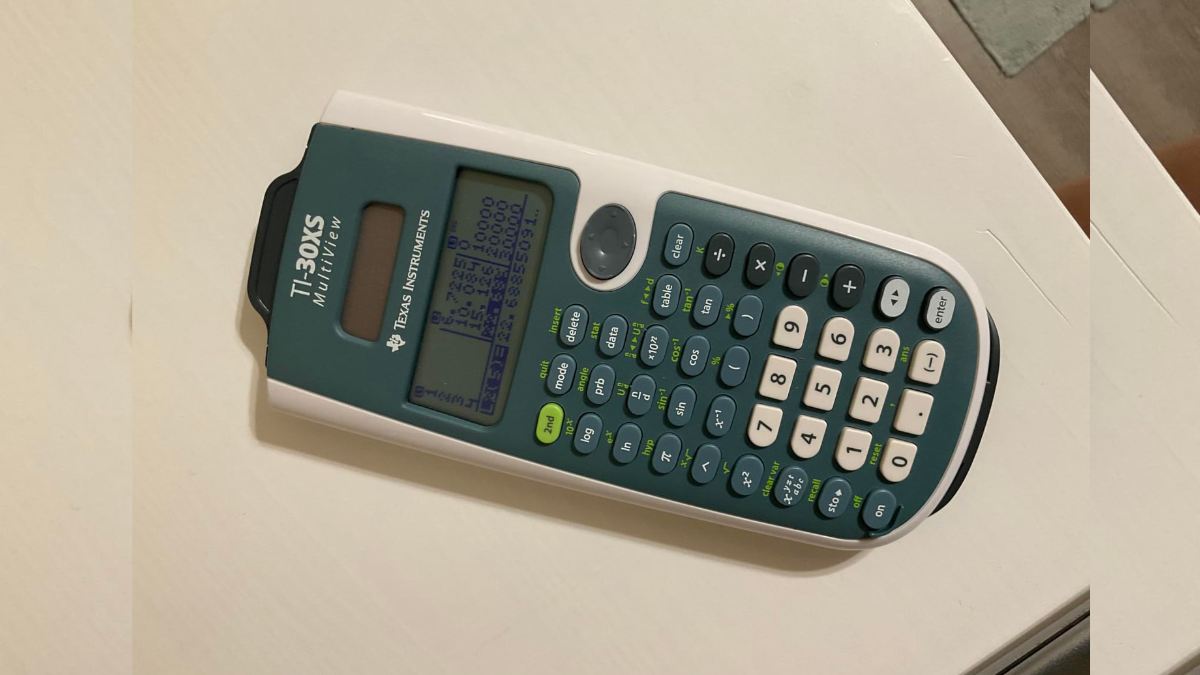
A scientific calculator is one of the most useful tools for students, educators, engineers, technicians, and anyone who regularly works with mathematics. Among the many calculator brands available, Texas Instruments has become a familiar name in classrooms and professional environments. Texas Instruments scientific calculators are designed to help users perform calculations that go beyond the capabilities of a basic calculator, making complex mathematical work faster and more manageable.
From arithmetic and fractions to trigonometry, statistics, algebra, and other advanced calculations, a scientific calculator can provide practical support across many subjects. The right Texas Instruments model can be especially valuable for students who are learning how mathematical concepts are applied to real-world problems.
What Is a Scientific Calculator?
A scientific calculator is designed for mathematical operations that require more functionality than simple addition, subtraction, multiplication, and division. Depending on the model, it may support functions involving powers, roots, logarithms, trigonometric calculations, fractions, scientific notation, statistics, and other mathematical processes.
Texas Instruments offers scientific calculators in different configurations, allowing users to select a model based on their educational level and requirements. Some are designed with straightforward interfaces for everyday school mathematics, while more advanced models provide extensive capabilities for higher-level mathematics and science.
The main advantage is convenience. Instead of performing a long calculation manually, users can enter the appropriate mathematical expression and allow the calculator to handle the numerical processing.
Useful for Mathematics Students
For students, a scientific calculator can become an important part of their school supplies. Mathematics often involves calculations that become increasingly complex as students move from basic arithmetic into algebra, geometry, trigonometry, and statistics.
A Texas Instruments scientific calculator can help students check calculations and work through numerical problems more efficiently. It can also make it easier to focus on understanding the mathematical method instead of spending excessive time performing repetitive arithmetic.
However, a calculator should be viewed as a learning aid rather than a replacement for understanding. Students still need to know which formula or mathematical process to use. The calculator simply helps perform the numerical portion accurately and efficiently.
Trigonometry and Scientific Calculations
Trigonometry is one area where scientific calculators become particularly useful. Problems involving sine, cosine, and tangent can require calculations that would otherwise take considerable time.
Scientific calculators can also be useful when working with angles, powers, roots, and scientific notation. These functions are commonly encountered in physics, engineering, chemistry, and advanced mathematics.
One important consideration is understanding the calculator’s settings. For trigonometric calculations, users may need to select the appropriate angle mode, such as degrees or radians. Entering a correct calculation while using the wrong mode can produce an incorrect result, so learning the calculator’s basic settings is essential.
Fractions and Algebra
Fractions are another area where a scientific calculator can make mathematical work easier. Depending on the model, users may be able to enter and display fractional values in a more understandable format.
This can be helpful when studying algebra, equations, ratios, and other mathematical topics. Rather than converting every fraction to a decimal manually, users can work with fractional expressions more conveniently.
Scientific calculators can also help with powers, roots, parentheses, and other algebraic operations. These capabilities become increasingly useful as mathematical expressions become more complicated.
Helpful for Science Subjects
The usefulness of a scientific calculator extends well beyond mathematics. Students studying physics, chemistry, biology, technology, and other science-related subjects often encounter calculations involving very large or very small numbers.
Scientific notation is particularly important in science. Measurements can range from microscopic quantities to enormous distances, and entering these values manually can increase the possibility of errors. A calculator designed for scientific calculations can simplify this process.
For physics students, a calculator may be used for calculations involving speed, acceleration, energy, force, waves, electricity, and other numerical relationships. Chemistry students may encounter calculations involving concentrations, molar quantities, measurements, and scientific notation.
Useful Beyond the Classroom
Texas Instruments scientific calculators are not limited to students. Depending on the model and applicable requirements, scientific calculators can also be useful for professionals and hobbyists.
Engineers, technicians, construction professionals, laboratory workers, and other technical users may need to perform calculations during their work. A dedicated calculator can be convenient when a computer or smartphone is unnecessary or unavailable.
A physical calculator can also provide a focused environment for calculations. There are no notifications, incoming messages, or unrelated applications competing for attention.
Understanding the Calculator Before Using It
One of the biggest challenges for someone purchasing a scientific calculator for the first time is learning how to use it effectively. Scientific calculators have more buttons and functions than basic calculators, and some operations may require secondary functions.
Taking time to understand the layout can make a major difference. Users should become familiar with entering numbers, using parentheses, accessing secondary functions, changing modes, working with fractions, and clearing previous calculations.
Reading the model’s user guide can also be helpful. Even experienced calculator users may discover functions they did not know were available.
Choosing the Right Texas Instruments Model
Not every user needs the same calculator. A student taking introductory mathematics may need only essential scientific functions, while someone studying advanced mathematics or engineering may benefit from a more capable model.
Before choosing a Texas Instruments scientific calculator, consider the subjects in which it will be used. Check whether the required functions are available and whether the calculator is permitted for school, examination, or professional use.
Display design is another factor worth considering. A clear display can make mathematical expressions easier to read and reduce input mistakes. Key layout and overall usability are also important, especially for students who will use the calculator frequently.
Battery life, power options, physical size, and durability may also influence the decision.
Building Confidence Through Practice
A calculator becomes more useful as the user becomes more familiar with it. Instead of learning every function at once, beginners can start with the operations they use most frequently.
For example, a student might first learn basic arithmetic, fractions, powers, roots, and scientific notation. Once these functions become familiar, they can move on to trigonometric and statistical features.
Practicing with actual homework problems is often one of the easiest ways to learn. Over time, users can develop a routine for entering expressions and checking their results.
Accuracy Still Depends on the User
Although scientific calculators can perform numerical operations quickly, users still need to enter information correctly. A misplaced decimal point, incorrect sign, missing parenthesis, or wrong angle setting can lead to an incorrect answer.
For this reason, it is good practice to estimate an answer before calculating whenever possible. An approximate expectation can help users identify obvious errors.
Students should also understand the difference between a calculator’s numerical result and the mathematical reasoning behind a problem. The calculator can provide a value, but it does not necessarily explain why a particular formula or method should be used.
A Practical Long-Term Investment
A quality scientific calculator can remain useful for years. Students may use the same calculator across several mathematics and science courses, while professionals can continue using one for routine calculations.
This makes the purchase more than a short-term school expense. Choosing a calculator that meets both current and likely future needs can provide better value than selecting a model based only on the requirements of one class.
Final Thoughts
A Texas Instruments scientific calculator can be a practical and dependable companion for mathematical and scientific work. Its purpose is not simply to produce answers quickly but to help users manage calculations that would otherwise be time-consuming and difficult to perform manually.
For students, it can support learning in mathematics, physics, chemistry, and other technical subjects. For professionals, it can provide a convenient way to perform calculations without relying on a computer or smartphone.
The most important step is choosing a model that matches the user’s needs. Consider the required mathematical functions, display, ease of use, school or examination requirements, and long-term usefulness before making a decision.
With regular practice, a scientific calculator can become an intuitive part of a student’s or professional’s workflow. Whether calculating fractions, solving numerical expressions, working with trigonometry, or handling scientific notation, the right Texas Instruments calculator can make everyday mathematical tasks considerably more convenient.