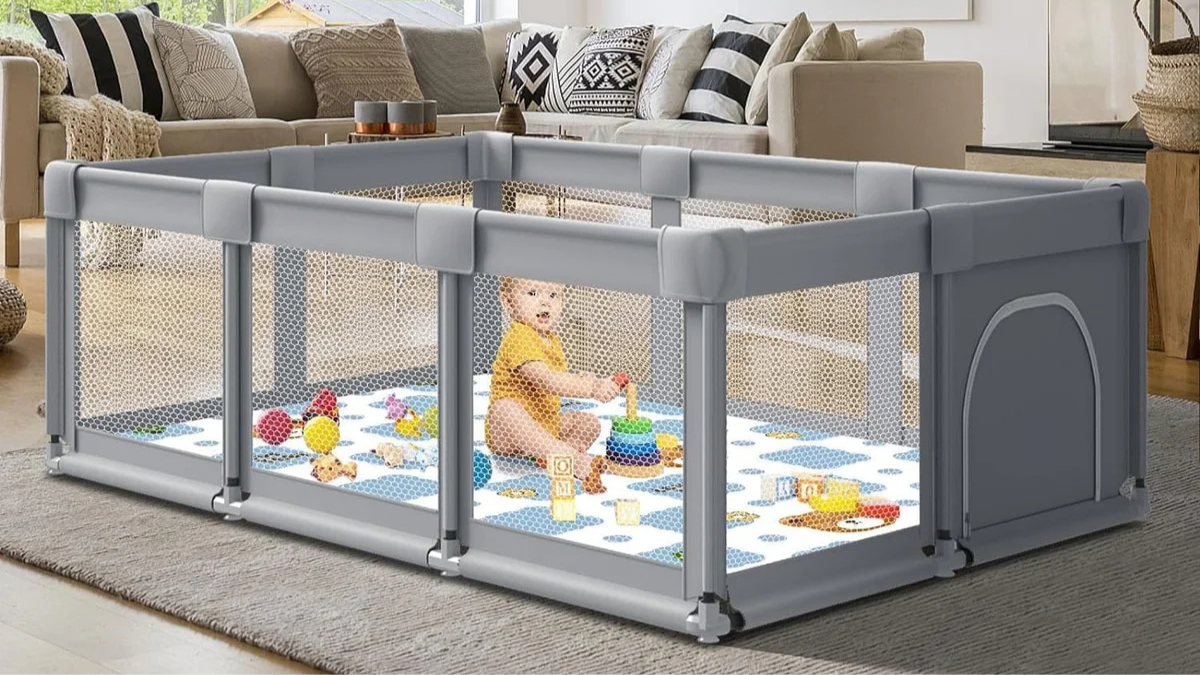
Creating a safe and comfortable environment for a baby is one of the most important responsibilities for parents and caregivers. As babies become more mobile, they begin to crawl, sit, stand, and explore their surroundings. At this stage, having a dedicated play area can make everyday routines easier while giving babies a defined space for supervised activity. The Fshibila Baby Playpen is designed to provide a contained area where babies can play, explore, and spend time safely under adult supervision.
It can be useful in many parts of the home. It can create a designated play area in a living room, bedroom, or other suitable space without requiring parents to constantly restrict a baby’s movement throughout the entire room.
This is an enclosed or partially enclosed play area designed for infants and young children. It gives babies room to move while creating a boundary between the child and potentially unsuitable areas of the home.
As babies develop mobility, ordinary household environments can contain many things that require attention, including electrical cords, furniture corners, small objects, cabinets, and other household items. A playpen can help establish a controlled area for play, although it should never replace active supervision.
The Fshibila Baby Playpen can be considered as part of a broader approach to creating an organized baby-friendly environment.
Encouraging Safe Exploration
Babies learn through movement and exploration. Crawling across a play area, reaching for toys, sitting independently, and practicing standing can all be part of normal development.
A dedicated playpen provides a defined area where parents can place age-appropriate toys and activities. This can make it easier for babies to explore without having access to every part of a room.
Babies need enough room to move comfortably rather than being confined to an unnecessarily small area. Parents should select a playpen that suits the child’s age, size, developmental stage, and available living space.
A Useful Area for Everyday Activities
A baby playpen does not have to be used only for traditional play. It can become a convenient space for several supervised activities throughout the day.
For example, parents may use the playpen for floor-based play, reading, practicing movement, or interacting with soft and age-appropriate toys. It can also provide a designated location for a baby while a caregiver is nearby performing a short household task.
The purpose is to create a predictable environment where the baby can spend time while remaining within the caregiver’s view and reach.
Design and Construction
Construction quality is an important consideration. Parents should look for a stable structure that is appropriate for the intended use and suitable for the child’s developmental stage.
Depending on the particular Fshibila Baby Playpen model, the design may include features intended to make the playpen easier to use or move. Parents should examine the exact product description for details about dimensions, materials, folding mechanisms, included accessories, and weight limits.
A playpen should be assembled according to the manufacturer’s instructions. Before placing a child inside, caregivers should make sure all components are properly secured and that the structure is stable.
Visibility and Supervision
Being able to observe a baby during play is an important consideration. Many playpens are designed with open or visible sides so caregivers can monitor the child while remaining nearby.
Good visibility can make it easier to notice when a baby becomes tired, uncomfortable, upset, or attempts to climb.
However, visibility does not mean that a playpen is a substitute for supervision. Babies should be monitored by a responsible adult, particularly when they are beginning to pull themselves up or become more physically active.
Parents should also avoid placing the playpen in locations where a baby could reach hazardous objects from inside the enclosure.
Creating an Engaging Play Area
A playpen becomes more useful when it contains safe, age-appropriate activities. Parents can provide a small selection of suitable toys rather than filling the entire space with objects.
Soft toys, baby-safe activity items, books, and other developmentally appropriate objects can provide opportunities for reaching, grasping, exploring, and interaction.
Toy selection should always be based on the child’s age and developmental stage. Small parts should be avoided when they could create a choking hazard.
Rotating toys can also help maintain interest. A few familiar toys can be replaced periodically with other suitable options, creating variety without overcrowding the play area.
One advantage of many modern playpens is their potential to make baby areas easier to organize. Instead of allowing toys and activities to spread throughout an entire room, parents can establish one dedicated zone.
If the particular Fshibila model is designed to be folded or moved, portability may also be useful for families who want to change the play area between rooms or store the playpen when it is not needed.
Before moving a playpen, caregivers should remove the baby and ensure that the structure is properly folded or secured according to the manufacturer’s instructions.
Choosing the Right Size
Size is one of the most important factors when purchasing a baby playpen. A larger playpen can provide more room for movement and activities, while a smaller model may be more suitable for homes with limited floor space.
Parents should measure the intended area before purchasing. It is also important to leave sufficient space around the playpen so that caregivers can comfortably access the child.
The internal dimensions should be considered alongside the child’s age and developmental stage. As babies become more mobile, they may benefit from having adequate space to crawl and move.
Safety Considerations
Parents should carefully read the manufacturer’s instructions and follow all age, weight, and usage recommendations.
The playpen should be placed on a stable, level surface and away from hazards such as stairs, heaters, open windows, cords, or furniture that a child could pull toward themselves.
Caregivers should regularly inspect the structure for loose components, damaged fabric, broken parts, or other signs of wear.
Once a baby becomes capable of climbing or attempting to climb over the sides, parents should reassess whether the playpen remains appropriate. The manufacturer’s guidance should be followed regarding age and developmental limitations.
Keeping the Playpen Clean
Babies frequently touch surfaces and then put their hands near their mouths, making cleanliness an important part of maintaining a play area.
Parents should clean the playpen according to the manufacturer’s care instructions. Washable surfaces can be cleaned as recommended, while removable fabric components should be handled according to their specific care requirements.
Toys and other items inside the playpen should also be cleaned regularly. Food, spills, and other debris should not be allowed to accumulate.
Regular cleaning also provides an opportunity to inspect the playpen for wear or damage.
Conclusion
They can provide a dedicated area for supervised play and exploration as babies become increasingly mobile. A well-organized playpen can help parents create a more controlled environment while giving babies room to interact with age-appropriate toys and activities.
The usefulness of a playpen depends on choosing an appropriate size, assembling it correctly, maintaining it properly, and using it according to the manufacturer’s instructions. Safety should remain a priority at every stage, especially as a child develops new abilities such as standing and climbing.
For parents looking to establish a defined play area at home, a baby playpen can be a practical addition to the household. With appropriate supervision, regular cleaning, and careful attention to developmental changes, it can become part of an organized and engaging environment for a growing baby.