A good floorstanding speaker is more than a device for producing sound. It can become an important part of a home entertainment system while also contributing to the appearance of a room. The VENERE tower speaker range from Sonus faber is a notable example of this approach, combining distinctive Italian-inspired design with conventional loudspeaker engineering. The Venere family includes several models, with the Venere 2.5 and Venere 3.0 serving as floorstanding tower speakers and other models designed for bookshelf, center-channel, and wall-mounted applications.
Elegant and Distinctive Design
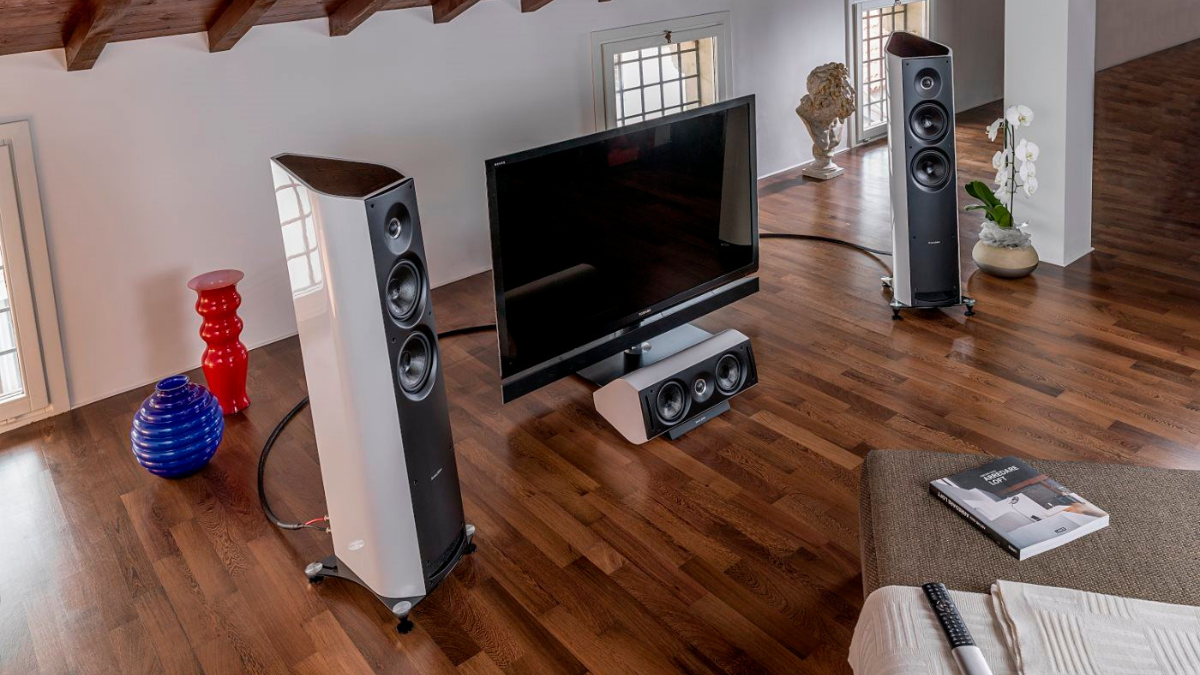
One of the first things that separates from many conventional floorstanding speakers is its cabinet design. Instead of using a simple rectangular box, the Venere series features a curved, lyre-inspired profile. Sonus faber’s documentation describes the design as being inspired by the company’s Aida loudspeaker while giving the Venere range a more contemporary character.
The curved cabinet is not simply decorative. A conventional speaker cabinet can develop internal standing waves and unwanted resonances. The Venere’s curved structure is designed to reduce these effects while also providing a rigid enclosure for the drivers. Independent reviews have similarly noted that the shape helps control cabinet resonances.
The speakers were offered in finishes including gloss black and gloss white, with some models and editions also available in wood finishes. Tempered glass and aluminum elements contribute to the modern appearance of the range.
Because of their tall floorstanding form, Venere speakers can also make a visual statement in a living room, dedicated listening room, or home theater.
A 2.5-way floorstanding speaker designed for stereo listening and home theater applications. Its driver arrangement includes a 29mm silk-dome tweeter and two 180mm drivers, with one handling midrange and woofer duties while the other is dedicated more specifically to low-frequency reproduction.
The speaker has a nominal impedance of 6 ohms and a recommended amplifier power range of 40 to 250 watts. Its dimensions are approximately 1,107mm high, 340mm wide, and 437mm deep.
One useful design feature is the front-facing reflex port. A front port can make speaker placement somewhat more flexible because the port is not firing directly toward the rear wall. Sonus faber specifically highlighted this characteristic as a way to make the speaker easier to place in a listening environment.
The Larger Venere 3.0
A larger floorstanding model in the original Venere family. It uses a three-and-a-half-way design with a 29mm silk-dome tweeter, a dedicated 150mm midrange driver, and two 180mm woofers.
The additional dedicated midrange driver gives the 3.0 a different configuration from the 2.5. The larger cabinet and additional driver arrangement are intended to provide greater scale and a broader presentation, making the speaker appropriate for larger listening spaces and more ambitious stereo or home theater systems.
The Venere 3.0 has dimensions of approximately 1,157mm high, 340mm wide, and 438mm deep. The manufacturer’s documentation lists an amplifier range of 40 to 300 watts.
Sound and Driver Technology
This is central to the Venere design. The tweeters use silk-dome construction, while the midrange and woofer drivers use Curv material. Sonus faber developed these drivers to provide controlled and dynamic reproduction across their respective frequency ranges.
The curved cabinet, driver arrangement, crossover design, and front reflex port all work together as part of the acoustic system. Rather than relying on one feature to create its sound, the speaker’s performance comes from the interaction between these components.
Independent measurements of the Venere 2.5 found a sensitivity of about 90dB over the specified measurement range. The same measurements showed a -3dB point around 52Hz and a -6dB point around 39Hz.
These figures help explain why the Venere 2.5 can deliver substantial bass from a floorstanding cabinet, although actual bass performance depends on room acoustics, amplifier choice, speaker placement, and listening position.
For music enthusiasts, a floorstanding speaker needs to reproduce more than simply loud bass. Vocal clarity, instrument separation, imaging, and overall balance are important parts of the listening experience.
As with any loudspeaker, personal preference plays an important role. Some listeners may prefer a warmer presentation, while others may want a more analytical sound. Room acoustics and amplification can also influence the final result.
Home Theater Applications
It was not designed only for two-channel stereo. The family included a center speaker, bookshelf models, and a wall-mounted speaker, making it possible to construct a multichannel home theater system around the same product family.
A pair can serve as the left and right channels in a home theater system. Adding a matching center speaker and surround speakers can create a more cohesive multichannel setup.
The floorstanding speakers can provide the main front soundstage, while the center channel handles dialogue and other central information. This makes the range suitable for users who want both music listening and movie playback from the same system.
Placement and Room Considerations
Speaker placement is extremely important for achieving good sound. Even a high-quality floorstanding speaker can perform differently depending on where it is positioned.
The Venere 2.5 and 3.0 use front reflex ports, which can offer more flexibility than rear-ported designs in some rooms. However, the speakers still need sufficient space around them for the soundstage to develop properly.
Listeners should experiment with the distance between the speakers, the listening position, and the surrounding walls. Small changes in placement can affect bass response and stereo imaging.
The size of the room should also influence the choice of model. The larger Venere 3.0 may be better suited to a spacious listening environment, while the Venere 2.5 can be appropriate for a smaller or medium-sized room.
Choosing an appropriate amplifier is another important part of building a speaker system. The published specifications list the Venere 2.5 with a recommended amplifier range of 40–250 watts and the Venere 3.0 at 40–300 watts.
These figures should not be interpreted as meaning that every amplifier within those ranges will sound identical. Amplifier design, current capability, room size, listening distance, and desired volume all affect system performance.
A properly matched amplifier should be capable of driving the speakers comfortably without clipping at the intended listening levels.
Venere S: The Signature Model
The Venere family was later expanded with the Venere S, also known as the Venere Signature. Introduced as the flagship of the Venere collection, the Venere S was designed and assembled by hand in Italy.
They uses a three-way design with three 180mm woofers, a dedicated midrange driver, and a mechanically decoupled silk-dome tweeter. Its specifications list 4-ohm nominal impedance, 90dB sensitivity, and a recommended amplifier range of 40 to 300 watts.
This model represents a more ambitious version of the Venere concept, combining the family’s distinctive styling with additional driver technology and a more substantial cabinet.
They offers several notable characteristics. Its distinctive cabinet design gives it a visual identity that differs from conventional rectangular tower speakers. The curved enclosure also serves an acoustic purpose by helping control unwanted resonances.
The range provides several configurations, allowing listeners to build stereo or multichannel systems. The use of dedicated midrange and bass drivers in the larger floorstanding models is another important feature.
The front reflex design can also make placement more convenient in certain rooms. In addition, the available amplifier specifications provide flexibility for users building systems around different amplification equipment.
Things to Consider
Potential buyers should remember that these are traditional passive loudspeakers rather than wireless all-in-one speakers. They require a suitable amplifier or AV receiver and appropriate speaker cabling.
Room size is another consideration. Floorstanding speakers require adequate space, and their performance can be affected by room acoustics. Buyers should also consider whether they need the larger 3.0 model or whether a smaller floorstanding or bookshelf configuration would better suit their room.
Because the Venere line is an older product family, availability can also depend on the market. Some models may be found through dealers or the used-audio market rather than as current new products.
Conclusion
The range demonstrates how loudspeaker design can combine visual character with acoustic engineering. Models such as the Venere 2.5 and Venere 3.0 use distinctive curved cabinets, silk-dome tweeters, Curv-based drivers, and front reflex ports to create floorstanding speakers intended for both music and home theater.
The Venere 2.5 provides a 2.5-way configuration with two 180mm drivers, while the larger Venere 3.0 adds a dedicated midrange driver and uses two 180mm woofers. The later Venere S expanded the concept further with three woofers and a more advanced three-way configuration.
For anyone interested in a floorstanding speaker that combines a distinctive appearance with traditional hi-fi design, the VENERE range is an interesting example. Its specifications, cabinet construction, driver technology, and system flexibility make it suitable for serious stereo listening as well as home theater applications.