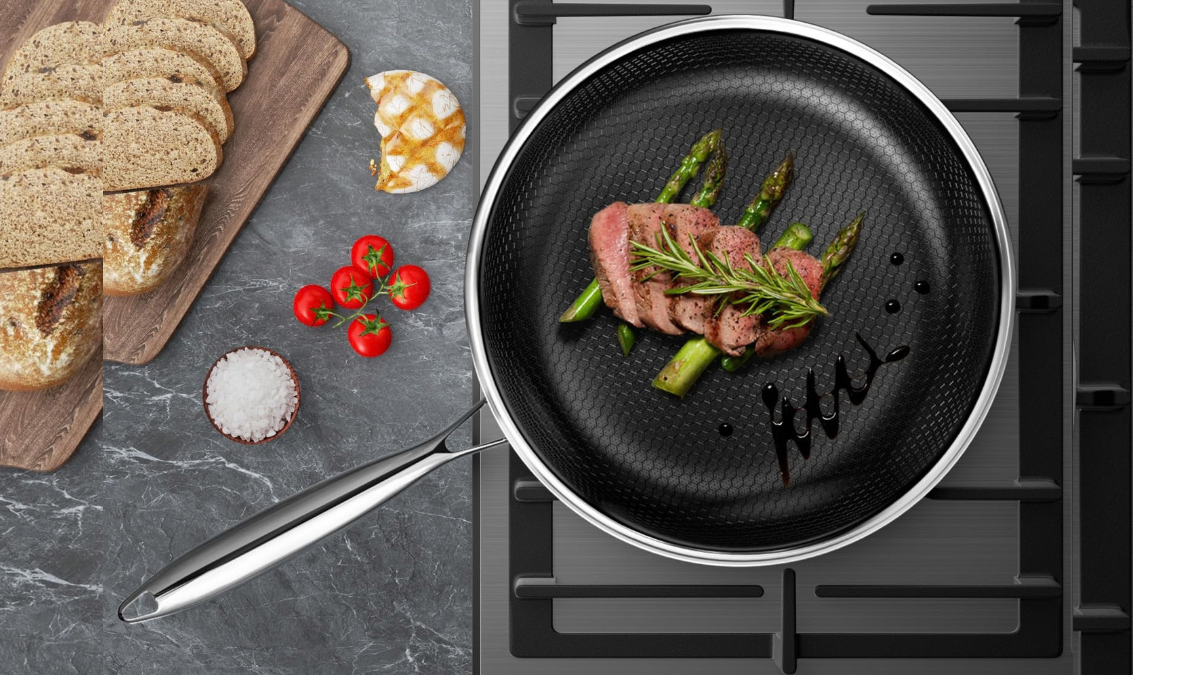
Choosing the right frying pan is an important part of creating a comfortable and efficient cooking experience. A good frying pan should distribute heat evenly, prevent food from sticking, be easy to clean, and last for a reasonable amount of time. The Innerwell Frying Pan is a cookware option designed for people who want the convenience of a nonstick cooking surface combined with the strength and appearance of stainless steel.
This frying pan is marketed as a combination of stainless steel construction and a ceramic nonstick surface, with some versions featuring a honeycomb-style interior and a glass lid. These features may appeal to home cooks who prepare eggs, pancakes, vegetables, fish, and other everyday meals. However, understanding the materials, proper use, and potential limitations is essential before deciding whether this pan is the right investment.
Design and Construction
One of the main attractions is its stainless steel construction. Stainless steel is widely used in cookware because it offers durability, corrosion resistance, and a clean, modern appearance. Compared with some lightweight cookware materials, a well-constructed stainless steel pan can provide a sturdy cooking surface for regular kitchen use.
The pan also features a ceramic nonstick cooking surface. This coating is intended to reduce food sticking and make cooking and cleaning easier. Depending on the particular model, the interior may have a textured or honeycomb-style design.
The overall combination aims to offer the durability associated with metal cookware and the convenience of nonstick cooking. Nevertheless, the actual performance depends on the precise construction, coating quality, thickness of the pan, and manufacturing standards. Buyers should confirm the specifications of the exact model rather than assuming every Innerwell frying pan has identical features.
This is one of the most important considerations when buying a frying pan. A good nonstick surface allows food to release more easily, reducing the need for excessive oil or butter.
For everyday meals, a nonstick pan can be particularly useful when preparing fried eggs, omelets, pancakes, delicate fish, and other foods that may break apart or stick to an ordinary metal surface. It can also make cooking more convenient for beginners because less effort may be required to turn and remove food.
However, nonstick performance is not guaranteed under every cooking condition. Food may still stick when the pan is overheated, when insufficient cooking fat is used, or when ingredients are added before the cooking surface is properly prepared.
Ceramic coatings can also lose some of their food-release performance with repeated use. Scratching, abrasive cleaning, excessive heat, and residue buildup may contribute to deterioration. Therefore, buyers should avoid assuming that a ceramic nonstick pan will remain perfectly slippery throughout its entire lifespan.
Stainless steel offers several practical advantages. It is generally resistant to rust and corrosion under normal kitchen conditions, provided the cookware is properly maintained. It also does not require the same seasoning process used for traditional cast-iron cookware.
Another advantage is its appearance. The polished metal exterior can complement modern kitchens and is relatively easy to maintain when cleaned appropriately.
However, stainless steel alone does not automatically guarantee excellent heat distribution. Performance depends on the pan’s design, thickness, and whether it incorporates an aluminum or copper heat-conducting layer. A pan with a suitable layered base may distribute heat more evenly than a thin, single-layer construction.
Before purchasing the Innerwell frying pan, buyers should check whether the manufacturer identifies it as fully clad stainless steel or stainless steel with a layered base. This information can help determine whether the pan is suitable for their cooking habits.
Is the Innerwell Frying Pan Safe?
Safety is an important consideration for any cookware product. The Innerwell frying pan’s ceramic nonstick marketing may appeal to buyers looking for an alternative to conventional nonstick coatings. However, words such as “titanium,” “ceramic,” and “non-toxic” are not enough to establish the exact chemical composition of a particular product.
Consumers should look for clear manufacturer documentation identifying the coating materials and stating whether the product is free from substances such as PFAS and PTFE, if those are specific concerns. A general claim about ceramic technology should not be treated as independent proof that every potentially concerning substance is absent.
Regardless of the pan’s coating, proper use is essential. Avoid heating an empty pan for extended periods, use low to medium heat for most nonstick cooking, and follow the manufacturer’s temperature limits. Wooden, silicone, or other manufacturer-approved utensils can help protect the cooking surface.
If the coating becomes extensively damaged, flakes off, or exposes the underlying metal, discontinue using the pan until the manufacturer clarifies whether it remains suitable for cooking.
Ease of Cleaning and Maintenance
Easy cleaning is another potential advantage of nonstick cookware. When food releases properly, many cooking residues can be removed with warm water, mild dishwashing liquid, and a soft sponge.
For best results, allow the pan to cool before washing it. Sudden temperature changes can cause thermal stress and may damage certain cookware components. Avoid steel wool, harsh scouring pads, and aggressive cleaning products unless the manufacturer explicitly permits them.
Food residue and grease should be removed after every use because accumulated buildup may affect cooking performance. Drying the stainless steel exterior after washing can also help maintain its appearance.
Although nonstick cookware can simplify cleaning, buyers should not assume the pan is dishwasher-safe. The manufacturer’s care instructions should determine whether machine washing is appropriate.
Compatibility With Different Cooktops
This is another feature worth checking before buying. Stainless steel cookware can be suitable for induction cooking, but not every stainless steel pan is induction-compatible.
For induction use, the pan must have a magnetic base designed to work with the cooktop. Buyers should look for an explicit induction-compatibility statement on the product listing or packaging.
Gas and conventional electric cooktops may offer broader compatibility, although the pan’s base design and temperature limits still matter. On gas stoves, flames should remain beneath the base rather than extending up the sides, helping protect the handle and exterior.
The pan’s dimensions should also suit the household. A smaller frying pan can be convenient for single servings and quick breakfasts, while a larger model may be better for family meals. Checking the stated diameter, cooking-surface dimensions, handle design, and included accessories can prevent disappointment.
Advantages and Potential Disadvantages
They has several potential advantages. Its stainless steel exterior offers a modern appearance, while the ceramic nonstick surface is intended to simplify cooking and cleaning. It may be suitable for everyday dishes and for people who prefer not to cook directly on an uncoated metal surface.
Nevertheless, there are limitations to consider. Ceramic coatings can gradually lose their nonstick properties. Product descriptions may not provide enough detail about the coating composition, manufacturing quality, or long-term durability. Furthermore, the pan’s actual heat distribution and induction compatibility depend on the exact model.
Price is another factor. A lower purchase price may be attractive, but the overall value depends on how long the pan performs well. A less expensive pan that requires frequent replacement may not provide better value than a more durable alternative.
Prospective buyers should therefore consider the price, warranty, return policy, verified customer reviews, and availability of replacement options before making a decision.
Tips for Getting the Best Results
To extend the useful life of the Innerwell frying pan, follow a few basic practices.
First, use low to medium heat for most nonstick cooking. High heat is not usually necessary for eggs, pancakes, and many everyday dishes, and excessive temperatures can accelerate coating deterioration.
Second, avoid metal utensils unless the manufacturer specifically approves them. Silicone, wood, or suitable heat-resistant utensils are generally gentler on nonstick surfaces.
Third, use a small amount of cooking oil when appropriate and avoid cooking sprays that may leave stubborn residue. Clean the pan gently after it cools.
Fourth, store the pan carefully. If other cookware is stacked inside it, place a protective layer between the cooking surfaces to reduce scratching.
Finally, follow the care instructions supplied with the exact model. These recommendations are more reliable than assuming that all ceramic-coated stainless steel pans have the same requirements.
They may be a practical option for people seeking convenient everyday cookware with a modern stainless steel design and a ceramic nonstick surface. Its intended benefits include easier food release, simpler cleaning, and versatility for preparing common household meals.
However, the product’s long-term value depends on the quality of its coating, its heat-distribution design, and how well it withstands repeated use. The words “titanium” and “ceramic” should not be treated as guarantees of superior durability or safety without supporting specifications.